
Rethinking How Hawaiʻi Learns ʻŌlelo
“Comprehensible Input Is the Magic”: Dr. Kalani Makekau-Whittaker on Rethinking How Hawaiʻi Learns ʻŌlelo
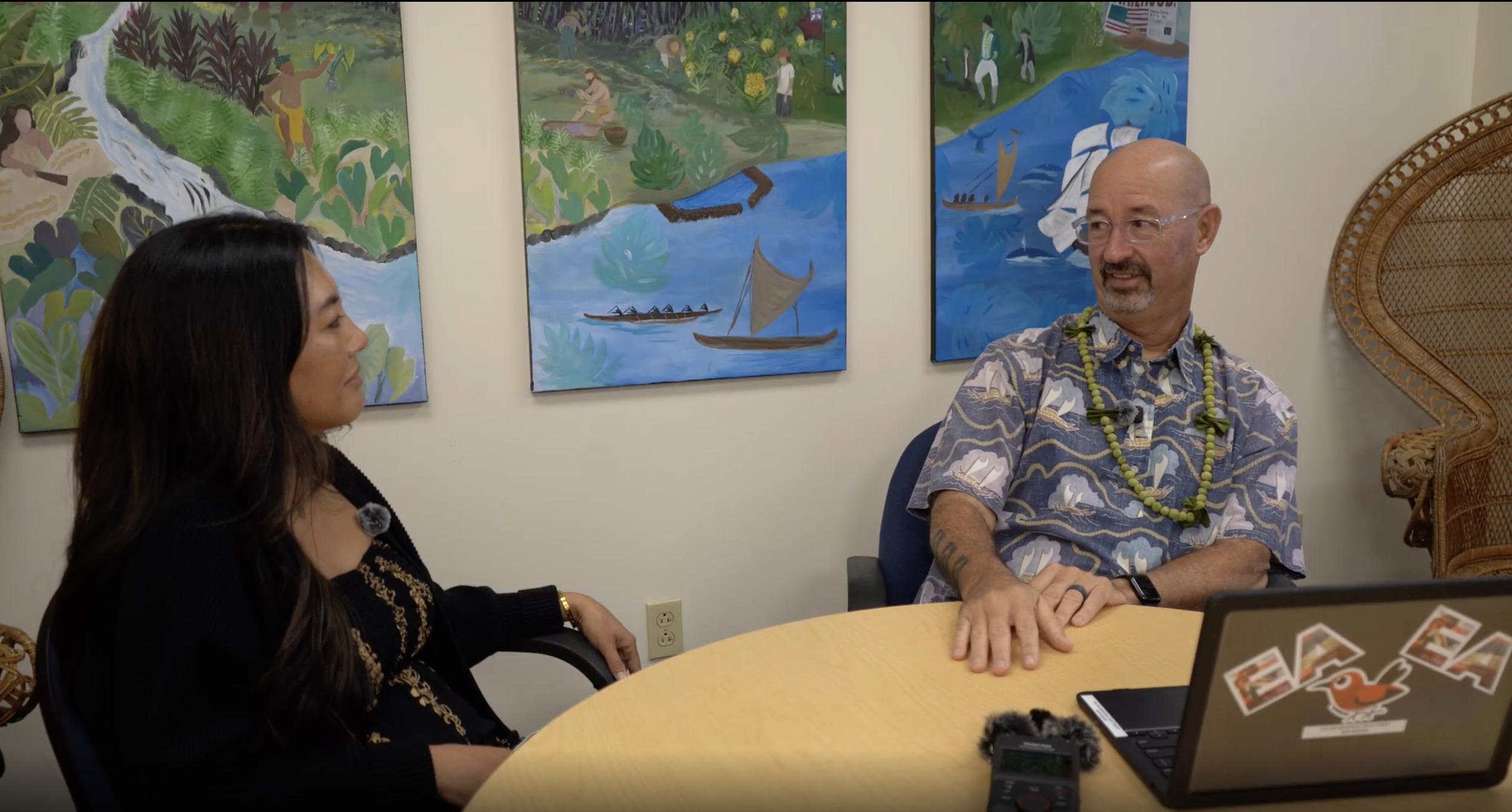
By Kolby Akamu Moser
HILO, Hawaiʻi — For Dr. Kalani Makekau-Whittaker, language isn’t a subject to be mastered — it’s something to be lived.
“We decided that Hilo would be a better place to raise our children in the language,” he said, reflecting on his family’s move from Oʻahu in 2001. “Just culturally, environmentally — just a better place for us.”
Born and raised on Oʻahu, Makekau-Whittaker’s path to becoming a leading voice in language acquisition wasn’t linear. As a child, he attended Japanese school from kindergarten through middle school. “I was one of the only non-Japanese people in there,” he said. “I think it made me more comfortable not completely understanding what’s going on around me in language.”
That early experience — learning to sit with not knowing — would later shape his philosophy on how languages are truly acquired.
He didn’t begin studying ʻŌlelo Hawaiʻi until college at the University of Hawaiʻi at Mānoa. What started as a requirement quickly became a calling.
“I was getting straight A’s in this, and broadcast journalism kind of faded away for me,” he said. “I just majored in Hawaiian language with no plan of where that would lead me. But I’ve come to learn that if you’re passionate in something and you just follow that passion, things will open up.”
In the early 2000s, the Hawaiian language movement was still rebuilding. Immersion schools had begun to stabilize speaker numbers, but native speakers — kūpuna who grew up with Hawaiian as a first language — were passing away.
“There was a decline with our native speakers,” he said. “I was fortunate that we had a lot of them around, and we spent as much time as we could sitting with them.”
Those experiences shaped his ear. Subtle pronunciation differences — like native speakers saying “aia” as “ai” — revealed to him the difference between classroom Hawaiian and community Hawaiian. “It’s not good or bad,” he said. “It’s just different. And I can identify that.”
Over time, however, his biggest shift came not from pronunciation — but from research.
Makekau-Whittaker began diving into second-language acquisition theory, studying scholars like Stephen Krashen and Bill VanPatten. What he discovered challenged decades of grammar-based instruction.
“After five decades of L2 research, what has become crystal clear is that language in the mind-brain is not built up from practice, but from consistent and constant exposure to input,” he said, quoting VanPatten.
In other words: practice doesn’t create fluency. Exposure does.
“We don’t acquire language when we speak,” he explained. “Speaking is the result of having acquired language.”
That concept — known as “comprehensible input” — now drives his teaching. From day one, his classes are 90 percent in the target language. No grammar lectures. No memorization drills. Instead, students are immersed in meaningful communication.
“If I started the class by explaining grammar rules, that’s not communicative anymore,” he said. “I had something I needed to accomplish, and I used language to accomplish it. That’s communicative context.”
He acknowledges that mistakes are part of the process — even necessary.
“When you start to acquire stuff in your head and try to create from that, it gets messy,” he said. “Mistakes all over the place. And it needs to be that way. That’s part of the process.”
Correction, he argues, doesn’t build acquisition. More input does.
The results, he says, are measurable. Nationally, he notes, traditional language classes produce fluency in only “six to seven percent” of students. In contrast, Hawaiian immersion programs approach near-total functional fluency.
“What are they doing in there that’s different?” he asked. “They’re getting comprehensible input in communicative context. They’re not instructing about the language — they’re communicating.”
Makekau-Whittaker believes the next frontier for Hawaiian language revitalization isn’t just more classes — it’s better materials. Comics. Contemporary stories. Content that is both understandable and interesting.
“When you’ve got those two things fulfilled in the input — comprehensible and interesting — that’s optimal,” he said. “Actually, according to Krashen, the most effective way to acquire grammatical features and vocabulary is voluntary, self-selected reading.”
He saw that firsthand with his own daughter. Raised exclusively in Hawaiian at home, she began reading English in fourth grade. Within two years, she tested into advanced English classes — despite minimal spoken English input.
“To me, that story kind of says something about reading,” he said. “The power of reading.”
So why learn ʻŌlelo Hawaiʻi?
“We live in Hawaiʻi. This is our home,” he said. “That’s the language of this land. Whether you’re Kānaka or not, you should engage with the language.”
But for him, it’s more than identity. It’s worldview.
In English, he explained, we say “I broke my arm,” implying agency. In Hawaiian, one says “Ua haki kuʻu lima” — “my arm broke.” The focus shifts from actor to outcome.
“It’s speaking to the result rather than an action with an agent,” he said. “Just that simple difference.”
For Makekau-Whittaker, language is not a checklist of grammar rules. It is relationship, story, worldview — and above all, input.
“If we could just understand how our brains actually acquire language,” he said, “we would either have to ignore that and keep teaching ineffectively — or we’d have to shift.”
His mission now is clear: shift.
And in doing so, help Hawaiʻi move beyond six percent — toward a future where ʻŌlelo Hawaiʻi is not just studied, but truly lived.